
Attending a watch auction effectively means combining rigorous preparation, disciplined bidding, and thorough authenticity evaluation to secure luxury timepieces at their true market value. Collectors who walk into a Sotheby's, Christie's, or Phillips auction room without a plan routinely overpay, miss key lots, or buy pieces with undisclosed condition issues. This guide covers every stage of the process, from registering as a bidder to calculating your true all-in cost, so you leave the sale room with a watch worth every dollar you spent.
What are the essential steps to prepare for a watch auction?
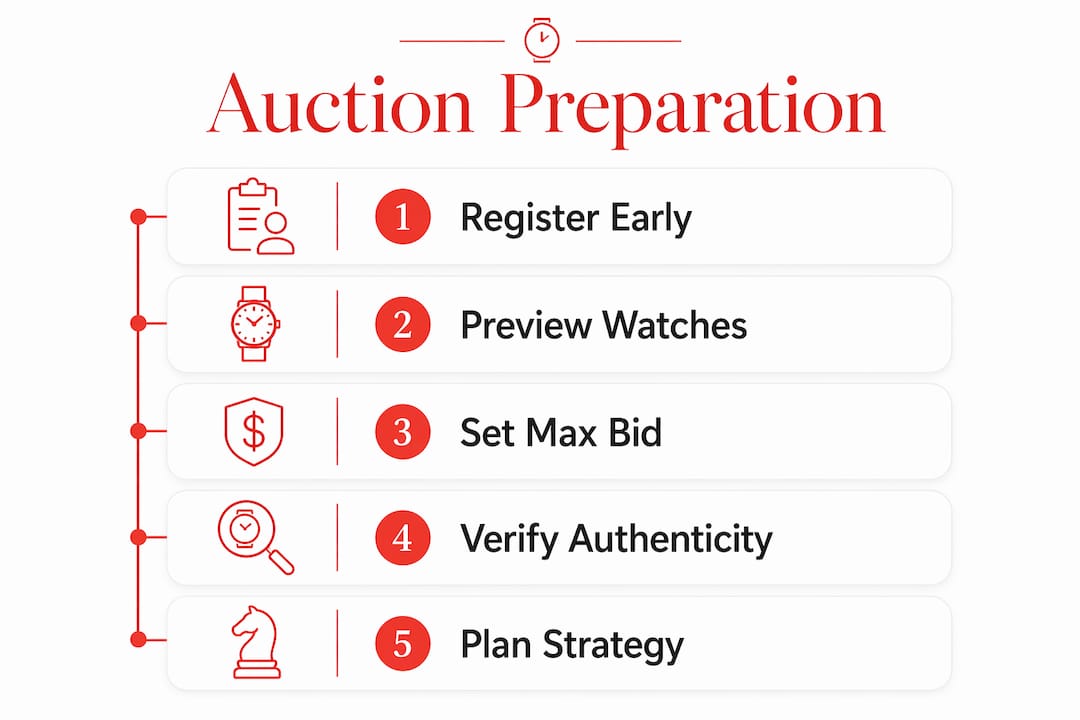
Preparation is the single biggest factor separating collectors who win at auction from those who regret their purchases. The process starts well before the sale date.
Register early and get your bidder number. You must register with the auction house and provide legal ID such as a passport to receive a bidder number, a requirement under Anti-Money Laundering regulations. This is a key difference from marketplace-style platforms that skip identity verification entirely. Complete registration days in advance, because late registration can cause technical delays that cost you bidding opportunities on the day.
Once registered, request the auction catalog as soon as it is published. Major houses like Sotheby's and Christie's publish detailed lot descriptions, provenance notes, and condition summaries. Study every lot you are interested in and cross-reference estimates against recent sold prices on platforms like Chrono24 or WatchCharts to build a realistic sense of fair market value.
Before auction day, build your preparation checklist:
- Download and study the full auction catalog for your target lots
- Request condition reports and supplementary photos directly from the auction house
- Attend the in-person preview, arriving at least 30 minutes early to reduce pressure
- Consult an independent specialist or watchmaker for high-value lots
- Write a precise maximum bid for each lot before you enter the room
Pro Tip: Set your maximum bid in writing before you arrive. Collectors who decide their ceiling on the spot almost always exceed it once the adrenaline of the room takes over.
The preview is where real preparation happens. Handling a Patek Philippe Nautilus or a Rolex Daytona in person reveals scratches, replaced parts, and dial inconsistencies that photographs never show. Arrive early to the preview at least 30 minutes before bidding begins to reduce psychological pressure and give yourself time to think clearly.
| Preparation step | Why it matters |
|---|---|
| Early registration | Avoids delays and secures your bidder number before the sale |
| Catalog research | Builds fair market value benchmarks for each target lot |
| In-person preview | Reveals condition issues photos cannot capture |
| Condition report request | Reduces unknown risk on as-is purchases |
| Written maximum bid | Prevents emotional overbidding during the sale |
How do you evaluate and authenticate watches before bidding?
Authentication is non-negotiable at auction because buying is almost always as-is with no post-sale remedies available. Once the hammer falls, the watch is yours regardless of what you discover afterward. This reality makes pre-auction inspection the most critical step in the entire process.
During the preview, examine the dial, case, and movement with a loupe if permitted. Look for signs of refinishing on the case, replaced hands or indices, and any mismatch between the reference number and the stated configuration. A Rolex Submariner with a "tropical" dial commands a significant premium, but only if the aging is genuine. Replaced dials on vintage Omega Speedmasters can cut value by 40% or more.
Key authentication checks to perform before bidding:
- Verify the serial number against the reference to confirm correct production year
- Check that the dial, hands, and case are all period-correct for the stated reference
- Inspect the movement through the caseback if accessible, looking for service marks and original parts
- Review provenance documentation including original box, papers, and service history
- Ask the auction specialist directly about any known repairs, replacements, or restoration work
Effective authentication hinges on condition reports and in-person previews, with supplementary photos providing additional certainty. For lots estimated above $10,000, bring an independent watchmaker or use a specialist consultant. The cost of an expert opinion is trivial compared to the cost of buying a misrepresented piece.
Pro Tip: Auction house specialists are there to help you. Ask every question you have, no matter how basic it seems. Treat every uncertainty about provenance or condition as a critical bidding variable, not a minor detail.
Specialist watch auctions and large auction houses with dedicated watch departments offer higher quality and better verified lots than general estate sales. Phillips, Antiquorum, and the dedicated watch departments at Christie's and Sotheby's employ in-house horological experts who vet lots before they appear in the catalog. General estate auctions carry significantly more authentication risk.
What strategies maximize bidding effectiveness at watch auctions?
The most effective bidding strategy is disciplined and planned, with every decision made before the adrenaline of the room takes over. Auctions are designed to create urgency. Your job is to resist it.
Understand your true all-in cost first. The hammer price is not what you pay. Auction houses add fees and taxes that often total 25 to 30% above the hammer price. A watch that hammers at $5,000 can cost you $6,500 or more once the buyer's premium, sales tax, and shipping are added. Calculate your all-in maximum before bidding, and treat the hammer price ceiling as a derived number, not your starting point.
Steps to calculate your true maximum bid:
- Identify the fair market value of the watch based on recent comparable sales
- Subtract the buyer's premium percentage (typically 20 to 25% at major houses)
- Subtract applicable taxes and estimated shipping or import duties
- The result is your maximum hammer price. Never exceed it.
- Write this number down and keep it visible during the sale
Pre-calculating your true all-in ceiling and walking away when exceeded saves money long-term. Winning a lot below the estimate but above your all-in ceiling is not a bargain. It is an overpayment with a flattering story attached.
Bidding method comparison:
| Method | Advantage | Risk |
|---|---|---|
| In-room bidding | Full control, read room dynamics | Emotional pressure, impulse raises |
| Phone bidding | Removes room pressure | Slight communication delay |
| Online bidding | Convenient, global access | Platform lag, sniping risk |
| Absentee bid | Disciplined ceiling enforced | No ability to react to room |
Late bidding or sniping is risky in live auctions because the auctioneer may close bidding before your signal is noticed. A confident bid during the natural flow of the sale is the safest approach, particularly for first-time bidders. Bid clearly and decisively when you want to participate, and stop the moment your pre-set ceiling is reached.
Pro Tip: If you are bidding in the room, sit where the auctioneer can see you clearly. Ambiguous paddle raises cause missed bids and frustration.
Auctions are emotionally charged environments. Setting firm limits before you enter is far safer than trying to assess value in real time while competing against experienced dealers and collectors. The discipline to walk away is the single most valuable skill you can develop.
What are the common mistakes to avoid when attending watch auctions?
Most auction losses are predictable and preventable. The same errors appear repeatedly among first-time and inexperienced bidders.
Mistakes that cost collectors money:
- Registering late and arriving without a confirmed bidder number
- Calculating only the hammer price and ignoring the buyer's premium, taxes, and shipping
- Skipping the in-person preview and relying solely on catalog photographs
- Entering a bidding war without a pre-set ceiling and raising bids on emotion
- Assuming post-sale returns or adjustments are possible on as-is lots
The most expensive mistake is misunderstanding the as-is nature of auction sales. No post-auction remedy is typical once the hammer falls. A first-bidder guide from MAKE1M emphasizes that preview and condition review are non-negotiable for significant purchases. Skipping the preview to save time is a false economy that can cost thousands.
"The best bidding strategy is disciplined and planned, avoiding emotional overspending especially at a first auction experience." This principle applies whether you are bidding on a $2,000 vintage Omega or a $200,000 Patek Philippe reference 5270.
Ignoring the full cost calculation is equally damaging. Collectors who focus only on the hammer price routinely win lots they cannot afford or that exceed fair market value once all fees are included. Build the complete cost model before you bid, not after.
For collectors exploring luxury watch investment strategies beyond the auction room, understanding how condition and provenance affect resale value is just as important as winning the lot in the first place.
Key takeaways
Attending a watch auction effectively requires early registration, rigorous in-person authentication, and a pre-calculated all-in maximum bid that accounts for buyer's premium, taxes, and shipping.
| Point | Details |
|---|---|
| Register early | Submit legal ID and complete registration days before the sale to avoid delays. |
| Calculate all-in cost | Add buyer's premium, taxes, and shipping to the hammer price before setting your ceiling. |
| Attend the preview | In-person inspection reveals condition issues that catalog photos never show. |
| Bid with discipline | Write your maximum bid before the sale and stop the moment you reach it. |
| Choose specialist auctions | Houses like Phillips and Christie's offer better-vetted lots than general estate sales. |
What I have learned from years at the auction block
The auction room has a specific kind of gravity. I have watched experienced collectors, people who know Patek Philippe references by heart, raise their paddle one bid too many because the room made them feel like they were winning something. They were not winning. They were paying more than the watch was worth because stopping felt like losing.
The most useful thing I ever did was start treating my written maximum bid as a contract with myself. Not a guideline. Not a suggestion. A hard stop. The watches I regret buying are the ones where I told myself "just one more increment." The ones I am proud of are the ones where I walked away and either found the same reference elsewhere or simply moved on.
Previews changed how I bid entirely. Spending 20 minutes with a lot before the sale, asking the specialist every question I could think of, and requesting the full condition report shifted my confidence from guesswork to informed judgment. Auction house specialists at Christie's and Phillips have always been willing to answer detailed questions. Use them. They know things about individual lots that never make it into the catalog.
My honest recommendation for anyone attending their first serious watch auction is to choose a specialist house over a general estate sale. The authentication standards are higher, the lot descriptions are more accurate, and the specialists on the floor are genuinely knowledgeable. You pay for that quality in the buyer's premium, but you also sleep better after the sale.
Build your auction knowledge with Timepiecepulse
Winning at auction starts with knowing what you are bidding on before you ever enter the room. Timepiecepulse provides in-depth luxury watch reviews covering Patek Philippe, Rolex, Audemars Piguet, and Omega, giving you the reference knowledge to evaluate lots with confidence.

Whether you are preparing for your first sale or refining your approach after a few auctions, the guides at Timepiecepulse cover authentication markers, investment value, and what separates a great buy from an expensive mistake. Use the site as your pre-auction research base and walk into every sale knowing exactly what each piece is worth.
FAQ
What do I need to register for a watch auction?
You need a valid government-issued photo ID such as a passport, along with contact and payment details. Most major auction houses require registration days in advance to complete compliance verification under AML regulations.
How much more than the hammer price will I actually pay?
Expect to pay 25 to 30% above the hammer price once the buyer's premium, applicable taxes, and shipping are included. A $5,000 hammer price can realistically become $6,500 or more at major auction houses.
Can I return a watch if I discover a problem after the auction?
No. Auction sales are almost always final and as-is, with no post-sale remedies available. This makes in-person preview and condition report review before bidding the only protection you have.
Is online bidding as effective as bidding in the room?
Online bidding offers convenience but carries risks including platform lag and the inability to read room dynamics. For high-value lots, in-room or phone bidding gives you better control and reduces the risk of a missed bid.
Which auction houses are best for buying luxury watches?
Specialist watch auctions at Phillips, Christie's, and Sotheby's offer better-vetted lots and more knowledgeable specialists than general estate sales. Antiquorum is also a strong choice for vintage and complicated timepieces.