A watch reference number is the single most precise identifier of a luxury timepiece’s model variant, encoding case material, dial configuration, size, and bezel type in one alphanumeric string. For investors and collectors, understanding why reference numbers matter in investing is not optional. It is the foundation of every sound purchase decision. Without this knowledge, you cannot reliably authenticate a Rolex Submariner, compare two Patek Philippe Nautilus variants, or determine whether a watch’s price reflects its true market position. Reference numbers are the language of serious watch investment.
Why reference numbers matter in watch investing
Reference numbers define model identity at a level serial numbers cannot. A serial number tells you when a specific unit left the factory. A reference number tells you what that unit is: the exact model, material, movement type, and configuration. Reference numbers enable precise model identification, including case size, material, dial, and bezel variants, making them critical for evaluating authenticity and comparing collector value. That distinction matters enormously when two watches look nearly identical but carry a price difference of tens of thousands of dollars.
Consider the Rolex Daytona. The reference 116500LN with a white dial and the same reference with a black dial are technically the same reference, yet secondary market prices diverge based on color preference and production run. Go one step further to the older reference 6263 in stainless steel versus gold, and you are looking at completely different investment profiles. The reference number is the map that tells you which territory you are in.
The investing reference number significance extends to rarity and historical context. Certain Patek Philippe references, such as the 1518 in stainless steel, are so rare that a single example sold for over $11 million at Phillips auction house. That valuation is inseparable from the reference itself. Without knowing the reference, you cannot begin to assess whether a watch is a trophy asset or an overpriced replica.
What is a watch reference number and where to find it
A reference number is a manufacturer-assigned code that identifies a specific product variant across an entire production run. It is a model-level identifier, not a unit-level one. Every Rolex Submariner reference 126610LN shares the same reference regardless of when it was made or who owns it. The serial number, by contrast, is unique to each individual watch.
Reference numbers are engraved in specific locations and appear on documentation, making them fundamental for value preservation. Here is where to find them on the most investment-relevant brands:
-
Rolex: Engraved between the lugs at the 12 o’clock position (reference) and 6 o’clock position (serial). Visible only when the bracelet is removed.
-
Patek Philippe: Found on the caseback and in the original papers. The reference typically appears alongside the movement number in the Extract from the Archives.
-
Omega: Printed on the caseback and inside the original box documentation. Older models have it engraved on the case itself.
-
Audemars Piguet: Engraved on the caseback, often alongside the serial number.
Reference numbers also encode meaningful information. A Rolex reference 126710BLNR tells you it is a GMT-Master II (126710), with a black and blue “Batman” bezel (BLNR). A Patek Philippe reference 5711/1A-010 tells you it is a Nautilus (5711), in stainless steel (/1A), with a blue dial (010). Learning to read these codes gives you immediate insight into what you are holding before you even open a catalog.
Pro Tip: Always remove the bracelet or strap before inspecting a Rolex in person. The reference and serial numbers between the lugs are the first physical verification point, and sellers who resist this request are sending a clear signal.
How do reference numbers help authenticate luxury watches?
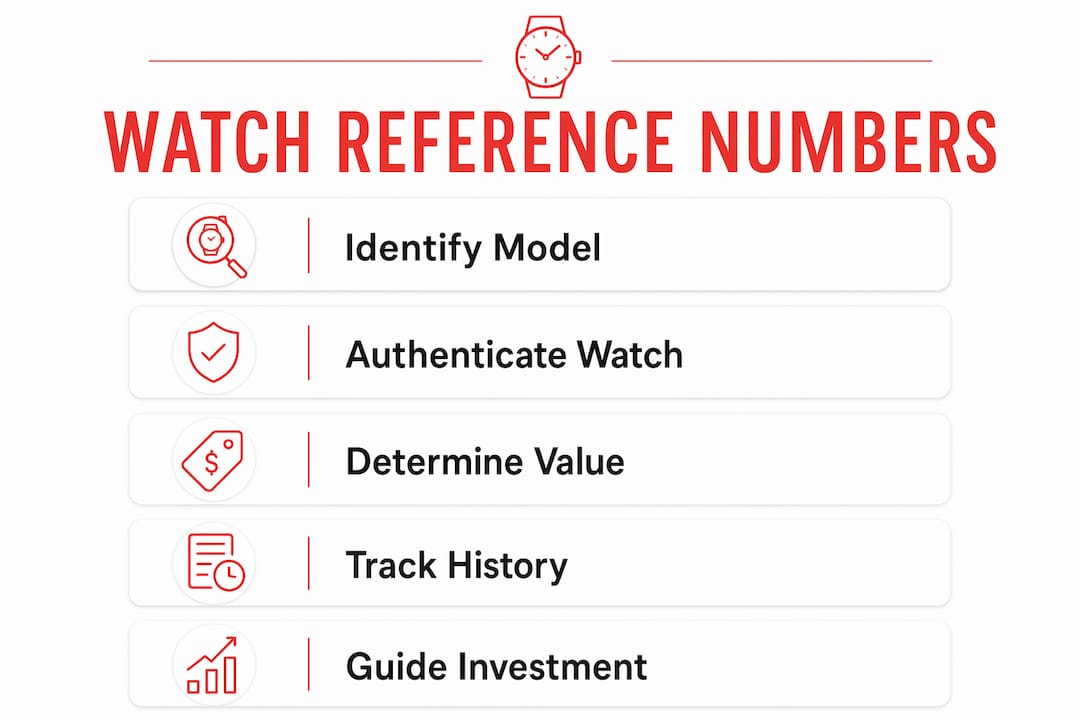
Authentication is where the importance of reference numbers becomes undeniable. Serial numbers alone are insufficient for authentication because counterfeiters replicate serials. Matching serial and reference numbers with physical and paperwork details is the minimum standard for any serious verification. A watch with a convincing serial but a mismatched reference is a counterfeit or a Frankenwatch, regardless of how good it looks.
A Frankenwatch is a watch assembled from genuine parts sourced from different examples of the same or similar models. It may contain an authentic movement, an authentic case, and authentic hands, but none of those parts originally belonged together. Detecting Frankenwatches requires verifying consistency across reference, case number, movement number, and dial configuration rather than relying on a single label. A watch may have genuine parts and plausible serials but still fail archive matching, exposing it as a non-original assembly.
The authentication process for a high-value piece should follow this sequence:
-
Locate the reference number physically on the watch and confirm it matches the paperwork.
-
Cross-check the serial number against the manufacturer’s production records for the stated reference and year.
-
Inspect the movement to confirm the caliber matches what the reference specifies.
-
Examine the dial for correct font, printing style, and lume application consistent with the reference’s production era.
-
Request archival verification for vintage or high-value pieces. Patek Philippe’s Extract from the Archives definitively confirms case, movement, and reference number alignment, costing about CHF 1,500 in 2026 and taking 4 to 8 weeks. This service is the gold standard for avoiding Franken-Pateks.
“The reference number acts as the anchor for defining model identity in watch authentication, while serial numbers identify individual units. Authenticating requires matching both plus physical watch details.” — We Know Watches
Common red flags include mismatched engravings, incorrect font styles for the production era, reference numbers that do not correspond to the stated year of manufacture, and paperwork with inconsistent formatting. Any single mismatch warrants a full stop and professional review before proceeding.
Pro Tip: For any watch above $5,000, budget for a professional authentication service. Professional valuation costs $50 to $150, which is negligible relative to the potential loss from purchasing a sophisticated counterfeit.
How reference numbers drive watch valuation and investment returns
Reference numbers do not just confirm what a watch is. They determine what it is worth. Original reference-consistent watches command significant premiums, while modified or redialed dials reduce value by 30 to 50 percent. That is not a minor discount. On a watch valued at $50,000, a non-original dial means a potential loss of $15,000 to $25,000 at resale.
The table below illustrates how variant differences within a single reference family translate to dramatically different market values:
| Watch model | Reference variant | Approximate market value (2026) |
|---|---|---|
| Rolex Daytona | 116500LN white dial | $28,000 to $35,000 |
| Rolex Daytona | 116500LN black dial | $25,000 to $30,000 |
| Patek Philippe Nautilus | 5711/1A-010 blue dial | $150,000 to $200,000 |
| Patek Philippe Nautilus | 5711/1A-001 black dial | $130,000 to $170,000 |
| Omega Speedmaster | 311.30.42.30.01.005 | $6,000 to $8,000 |
The differences within a single model family are not cosmetic. They reflect collector demand, production rarity, and historical significance, all of which are indexed to the reference number. Investors who treat all variants of a reference as interchangeable will consistently overpay or undersell.
Reference numbers also unlock access to comparable sales data. Platforms like Chrono24, Bob’s Watches, and auction records from Christie’s and Phillips organize their data by reference number. When you search for a specific reference, you get a precise picture of recent transaction prices, not a blurred average across multiple variants. This is how professional watch investors build price models and identify undervalued pieces.
Practical steps for using reference numbers when buying or selling
Knowing why reference numbers matter is only useful if you apply that knowledge at every stage of a transaction. Here is how to do it systematically:
-
Before viewing a watch, research the exact reference number using manufacturer databases, WatchIQ, or trusted dealer catalogs. Know what the correct engravings, dial text, and case specifications should look like before you arrive.
-
During inspection, physically locate the reference number on the watch. Compare it against the box, papers, and any service records. Confirm the serial number falls within the correct production range for that reference.
-
Ask the seller directly whether any parts have been replaced, serviced with non-original components, or if the dial has been refinished. A refinished dial on a vintage Rolex or Patek Philippe is a material change that affects the reference’s integrity and resale value.
-
Request archival documentation for any vintage piece above $10,000. For Patek Philippe, this means the Extract from the Archives. For Rolex, this means original papers with matching reference and serial numbers.
-
Use reference numbers to catalog your collection. A personal reference library, organized by brand, reference, and acquisition details, becomes a powerful tool for tracking value changes and preparing for future sales.
Luxury watch authentication guides consistently show that investors who skip documentation checks and third-party verification are the primary victims of sophisticated counterfeits. The reference number is your first line of defense, but it only works when you use it actively.
Pro Tip: Build a spreadsheet for every watch you own or consider buying. Include the reference number, serial number, production year range, original retail price, and current market comparables. This takes 20 minutes per watch and saves hours of research at the point of sale.
Key takeaways
Reference numbers are the definitive model identifiers in luxury watch investing, and every authentication, valuation, and transaction decision must be anchored to them.
| Point | Details |
|---|---|
| Reference vs. serial numbers | Reference numbers identify the model variant; serial numbers identify the individual unit. Both are required for authentication. |
| Authentication requires cross-checking | Match reference, serial, movement, and dial against production records to detect counterfeits and Frankenwatches. |
| Valuation impact is significant | Non-original or mismatched components reduce watch value by 30 to 50 percent relative to reference-consistent examples. |
| Archival verification is the gold standard | Patek Philippe’s Extract from the Archives costs CHF 1,500 and is the most reliable tool for confirming reference authenticity. |
| Catalog every piece by reference | A personal reference library organized by model, variant, and documentation is the foundation of a serious investment collection. |
What I have learned from years of reference number verification
The single most expensive mistake I see collectors make is trusting a watch’s appearance over its documentation. A beautifully preserved dial and a convincing serial number are not authentication. They are the starting point. I have personally reviewed watches that passed a visual inspection but failed the moment the reference number was cross-checked against production records. In one case, a vintage Patek Philippe with an asking price above $80,000 had a reference number that did not correspond to the stated production year by nearly a decade. The seller was not necessarily dishonest. They had simply never verified it themselves.
The counterfeit market has evolved significantly. Modern fakes replicate not just the visual appearance but the engravings, the paperwork, and even the service history. What they cannot replicate perfectly is the internal consistency of a watch that was assembled correctly at the factory and has remained original throughout its life. That consistency is only detectable when you check the reference against every other identifier on the watch and in the archive.
My advice to anyone building a serious collection is to treat reference number verification as non-negotiable, not as an optional step for expensive pieces. The investment-grade watch market rewards collectors who understand what they own at a granular level. The reference number is the grammar of that language. Learn it before you spend.
Explore Timepiecepulse for expert watch investment resources
Timepiecepulse is built for collectors and investors who take authentication and valuation seriously. Whether you are researching a specific Rolex reference before a purchase or comparing Patek Philippe variants for portfolio decisions, the guides and reviews at Timepiecepulse give you the depth you need.
Browse premium watch reviews covering investment-grade timepieces from Rolex, Patek Philippe, Audemars Piguet, and Omega, with detailed authentication notes and market context for each reference. The Timepiecepulse watch guide also covers authentication best practices, market trend analysis, and curated selections of Swiss-made watches that meet the standards serious collectors demand. Every piece featured is assessed for originality, reference consistency, and long-term investment potential.
FAQ
What is a watch reference number?
A watch reference number is a manufacturer-assigned alphanumeric code that identifies a specific model variant, encoding details like case material, dial type, and bezel configuration. It is a model-level identifier, distinct from the serial number, which identifies an individual unit.
How do reference numbers help detect counterfeit watches?
Authenticators combine reference and serial numbers with physical inspection and paperwork to verify a watch’s legitimacy, since counterfeiters frequently replicate serials but cannot perfectly replicate the internal consistency of a factory-original assembly.
Where is the reference number located on a Rolex?
On Rolex watches, the reference number is engraved between the lugs at the 12 o’clock position and is only visible when the bracelet is removed. It also appears on the original box and papers.
How much does archival verification cost for a Patek Philippe?
The Patek Philippe Extract from the Archives costs approximately CHF 1,500 in 2026 and takes 4 to 8 weeks to complete. It confirms the alignment of case, movement, and reference number against the original factory production records.
Do reference numbers affect resale value?
Reference-consistent watches with original, unmodified components command the highest prices. Modified or redialed watches lose 30 to 50 percent of their value compared to fully original examples of the same reference.