
Jewel count verification is the process of confirming the exact number of functional synthetic ruby bearings in a watch movement to validate its authenticity and mechanical complexity. Every serious collector needs to understand this process, because a misrepresented jewel count is one of the clearest signs of a counterfeit or altered watch. Manual-wind movements use 17 jewels, automatics use 21–25, chronographs use 25–30+, and highly complicated movements use 40 or more. These numbers are not arbitrary. They reflect the engineering architecture of the movement itself, and any deviation from expected counts demands explanation.
What is jewel count verification and how does it work?
Jewel count verification confirms that the number of synthetic ruby bearings inside a movement matches what the manufacturer specifies for that caliber. The industry term for these bearings is "functional jewels," and ISO 1112 mandates that only friction-reducing jewels serving a mechanical purpose count toward the marked total. Decorative jewels added purely for appearance do not qualify under this standard.
The jewel count process begins with movement inspection. A watchmaker removes the caseback and examines the movement's top plate, bridges, and rotor assembly. Jewels appear as small red or pink stones set into polished metal chatons or pressed directly into the plate. Counting them requires either direct visual inspection under magnification or reference to the manufacturer's caliber documentation.
Here is what the jewel count process covers during a standard inspection:
- Top plate jewels: Bearings for the gear train, including the center wheel, third wheel, fourth wheel, and escape wheel
- Balance cock jewel: The bearing supporting the balance wheel pivot, one of the most critical friction points
- Pallet fork jewels: The entry and exit stones that control the escapement
- Keyless work jewels: Bearings in the setting and winding mechanism, present in higher-count movements
- Rotor bearing jewels: Found in automatic movements to support the oscillating weight
Pro Tip: You can perform a preliminary jewel count check without full disassembly. Remove the caseback, use a loupe at 5x or 10x magnification, and count the visible red stones on the top plate and balance cock. Compare your count to the manufacturer's published caliber specifications. This will not replace a professional inspection, but it catches obvious discrepancies fast.
Historical context matters here. Jewel inflation was a common marketing tactic in vintage watches, where manufacturers added non-functional jewels to boost the advertised count and charge more. Some vintage pieces carry jewel counts that exceed what their movement complexity actually requires. ISO 1112 was introduced specifically to stop this practice and standardize what counts as a functional jewel.

Does jewel count tell you how good a watch is?
Jewel count signals movement complexity, not quality. This distinction matters enormously for collectors evaluating a purchase. A 17-jewel movement covers every critical friction point in a standard manual-wind watch and is considered fully jeweled for that movement type. Adding more jewels to a simple movement does not improve its performance.
The standard counts by movement type are:
- 17 jewels: Fully jeweled manual-wind movement, covering all essential bearings
- 21–25 jewels: Standard automatic movement with rotor bearing and additional keyless work jewels
- 25–30+ jewels: Chronograph movements with added complications requiring extra bearings
- 40+ jewels: Highly complicated movements such as perpetual calendars or minute repeaters
A 17-jewel master-crafted watch can outperform a 30-jewel mass-produced movement. The engineering behind the movement, the quality of the alloys used, the finishing of the surfaces, and the precision of the assembly all determine real-world performance far more than jewel count alone.
"Collectors should view jewel counts as a reflection of movement layout, not as a quality shortcut. Craftsmanship and movement engineering matter most." — Aorawatime horological guide
Factors beyond jewel count that determine watch quality include:
- Movement finishing: Techniques such as Geneva stripes, beveling, and circular graining on bridges
- Escapement design: The lever escapement versus a co-axial escapement affects long-term accuracy
- Alloy quality: The grade of steel used in the gear train affects wear resistance
- Regulation: How precisely the movement has been adjusted across multiple positions
- Complication engineering: The mechanical logic behind added functions like power reserve or date displays
Pro Tip: Never judge a watch's quality by jewel count alone. A Patek Philippe caliber 215 with 18 jewels outperforms countless movements with higher counts because of its hand-finishing, regulation, and engineering precision. Use jewel count as one data point, not a verdict.
How does jewel count verification catch counterfeit watches?
Jewel count discrepancies are one of the clearest red flags in counterfeit detection. Modern luxury watches comply with functional-only jewel counts, so any deviation from the manufacturer's published specification warrants immediate suspicion. A watch claiming a jewel count that exceeds what its movement architecture requires is either misrepresented or modified.
The table below shows typical jewel counts for authentic movements versus counts that should raise concern:
| Movement type | Authentic jewel count | Suspicious count |
|---|---|---|
| Standard manual-wind | 17 jewels | 21+ with no added complications |
| Standard automatic | 21–25 jewels | 30+ with no chronograph or calendar |
| Chronograph | 25–30 jewels | 35+ without a complication to justify it |
| Complicated (perpetual calendar) | 33–40+ jewels | Count below 30 for a claimed perpetual |
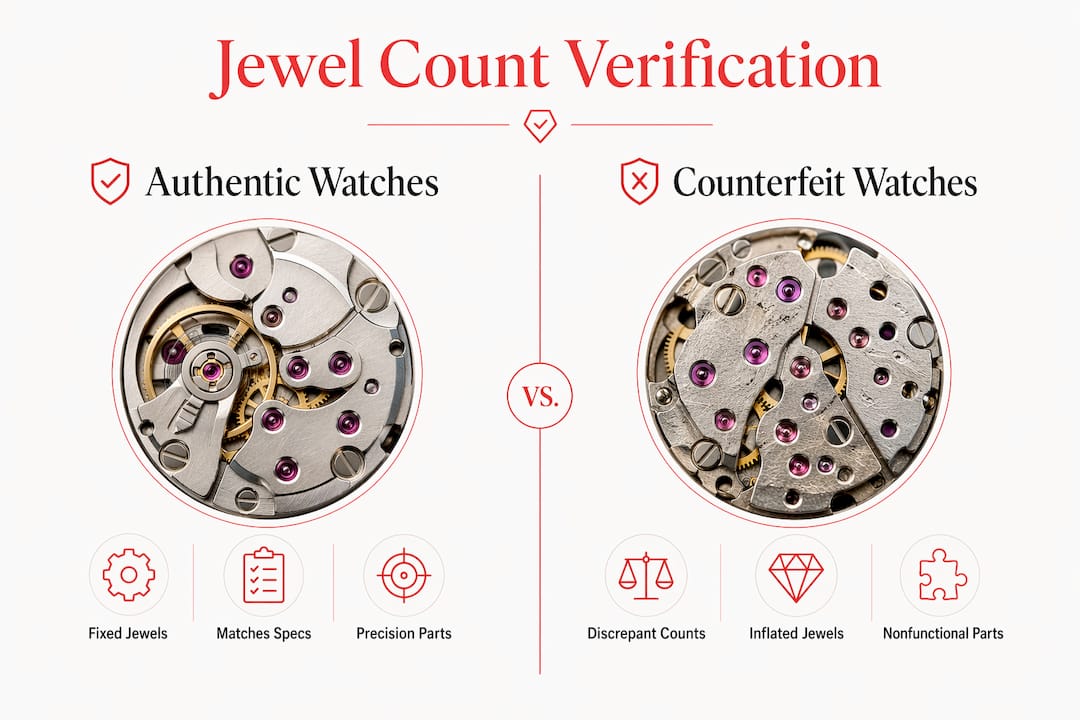
Jewel count is fixed by design and cannot be changed after manufacturing without damaging the movement. This makes it a reliable architectural fingerprint. If a seller claims a movement has more jewels than the caliber documentation supports, the movement has either been swapped or the documentation is false.
Vintage pieces require extra scrutiny. The era of jewel inflation means some older watches carry inflated counts on their dials that do not reflect functional jewels under modern ISO 1112 standards. A watch marked "21 jewels" from the 1960s may include several decorative stones that a modern watchmaker would not count.
Pro Tip: Always combine jewel count verification with caliber number matching and serial number verification. Cross-reference the caliber number engraved on the movement with the manufacturer's published specifications for that caliber. Rolex, Patek Philippe, Audemars Piguet, and Omega all publish caliber documentation that lists the correct jewel count for each movement.
What are the best practices for verifying jewel count accuracy?
The most reliable approach to jewel count accuracy combines visual inspection with professional appraisal. Start with what you can verify yourself, then escalate to expert confirmation before any significant purchase.
Follow these steps when verifying jewel count on a luxury watch:
- Request the caliber number from the seller before inspection. Every Swiss movement has a caliber designation engraved on the movement plate or bridge.
- Cross-reference the caliber against the manufacturer's published technical documentation or a trusted horological database.
- Inspect the movement visually using a loupe or watchmaker's eyeglass. Count the visible jewels on the top plate and compare to the expected count.
- Consult an authorized dealer or certified watchmaker for any watch above $5,000 in value. They have the tools and caliber knowledge to verify counts definitively.
- Request a service history for pre-owned watches. A legitimate service record from an authorized service center confirms the movement has not been altered.
Red flags to watch for during the jewel count verification process:
- A jewel count marked on the dial that does not match the caliber documentation
- Jewels that appear loose, misaligned, or inconsistently set under magnification
- A movement that has been polished heavily, which can obscure original engravings
- Seller reluctance to allow movement inspection before purchase
- Jewel counts that exceed what the movement's complication level justifies
Jewels used solely for marketing add no performance benefit and can actually complicate servicing. A watchmaker who encounters non-functional jewels during a service must work around them, which adds time and cost.
Pro Tip: When speaking with a seller or technician, ask directly: "What is the caliber number, and what jewel count does the manufacturer specify for that caliber?" A knowledgeable seller answers immediately. Hesitation or vagueness is a signal worth noting. For second-hand purchases, reputable watch platforms list caliber details in their listings, making pre-purchase verification straightforward.
Authorized dealers for Rolex, Patek Philippe, and Audemars Piguet can confirm jewel counts during a service appointment. Rolex authentication requires authorized dealer or watchmaker inspection for full verification. Serial number checks available online provide a starting point, but they do not replace physical movement inspection for jewel count accuracy.
For collectors buying at auction, jewel count verification becomes part of the broader due diligence process. Understanding how reference numbers connect to authentication gives you a framework for cross-checking jewel counts against the correct movement specification for each reference.
Key Takeaways
Jewel count verification is a fixed architectural check that confirms movement authenticity, and any count that deviates from the manufacturer's caliber specification is a red flag worth investigating.
| Point | Details |
|---|---|
| ISO 1112 defines the standard | Only functional friction-reducing jewels count; decorative jewels are excluded from the marked total. |
| Jewel count signals complexity, not quality | A 17-jewel manual-wind can outperform a 30-jewel mass-produced movement in real-world accuracy. |
| Discrepancies reveal counterfeits | A jewel count exceeding what the movement's complications require is a clear authentication warning sign. |
| Combine verification methods | Match jewel count with caliber number, serial number, and authorized dealer confirmation for full authentication. |
| Vintage watches need extra scrutiny | Pre-ISO 1112 pieces may carry inflated counts that include non-functional decorative jewels. |
Why jewel count verification changed how I evaluate watches
I used to treat jewel count as a prestige number, the way a car buyer might fixate on horsepower. More jewels meant a better watch. That thinking cost me credibility early on when I recommended a vintage piece to a collector friend, only for a watchmaker to find that several of its "jewels" were purely decorative stones added in the 1950s to justify a higher retail price.
That experience taught me something the spec sheets do not say directly. Jewel count verification is not about finding the highest number. It is about confirming that the number you see matches the movement's actual engineering. A Patek Philippe caliber 240 with its 27 jewels tells a completely different story than a generic 27-jewel movement from a budget manufacturer. The count is the same. The craftsmanship is not.
What I now recommend to every collector is this: treat jewel count as a consistency check, not a quality score. If the count matches the caliber documentation and the movement shows no signs of modification, you have cleared one important hurdle. Then you move on to finishing quality, regulation records, and provenance. Jewel count verification is the starting gate, not the finish line. The collectors who get this right are the ones who build portfolios that hold value over decades.
Explore Timepiecepulse for trusted watch authentication guides
Timepiecepulse covers the technical details that matter most to serious collectors, including jewel count verification, caliber documentation, and movement authentication across the most respected Swiss brands.
Whether you are evaluating a Rolex, Patek Philippe, Omega, or Audemars Piguet, the luxury watch reviews on Timepiecepulse give you the caliber-level detail you need to buy with confidence. Each review addresses authenticity indicators, movement specifications, and the factors that drive long-term value. If you are building a collection or making a single significant purchase, start with a resource that treats authentication as seriously as you do.
FAQ
What is jewel count verification in a watch?
Jewel count verification confirms the number of functional synthetic ruby bearings in a watch movement matches the manufacturer's specification for that caliber. It is a key step in authenticating both new and pre-owned luxury watches.
How many jewels should a genuine Rolex have?
Most Rolex movements use between 26 and 31 jewels depending on the caliber. The Rolex caliber 3235, used in the Datejust and Day-Date, contains 31 jewels, all of which are functional under ISO 1112 standards.
Can jewel count alone confirm a watch is authentic?
Jewel count alone is not sufficient for full authentication. Jewel count verification works best alongside caliber number matching, serial number checks, and inspection by an authorized dealer or certified watchmaker.
Why do some vintage watches have inflated jewel counts?
Jewel inflation was a marketing practice where manufacturers added non-functional decorative jewels to boost the advertised count and justify higher prices. ISO 1112 ended this practice by requiring that only functional friction-reducing jewels be counted.
Does a higher jewel count mean a more accurate watch?
No. Accuracy depends on movement engineering, regulation, and finishing quality. Adding jewels beyond essential friction points provides no accuracy benefit and can complicate servicing if the extra jewels serve no mechanical function.