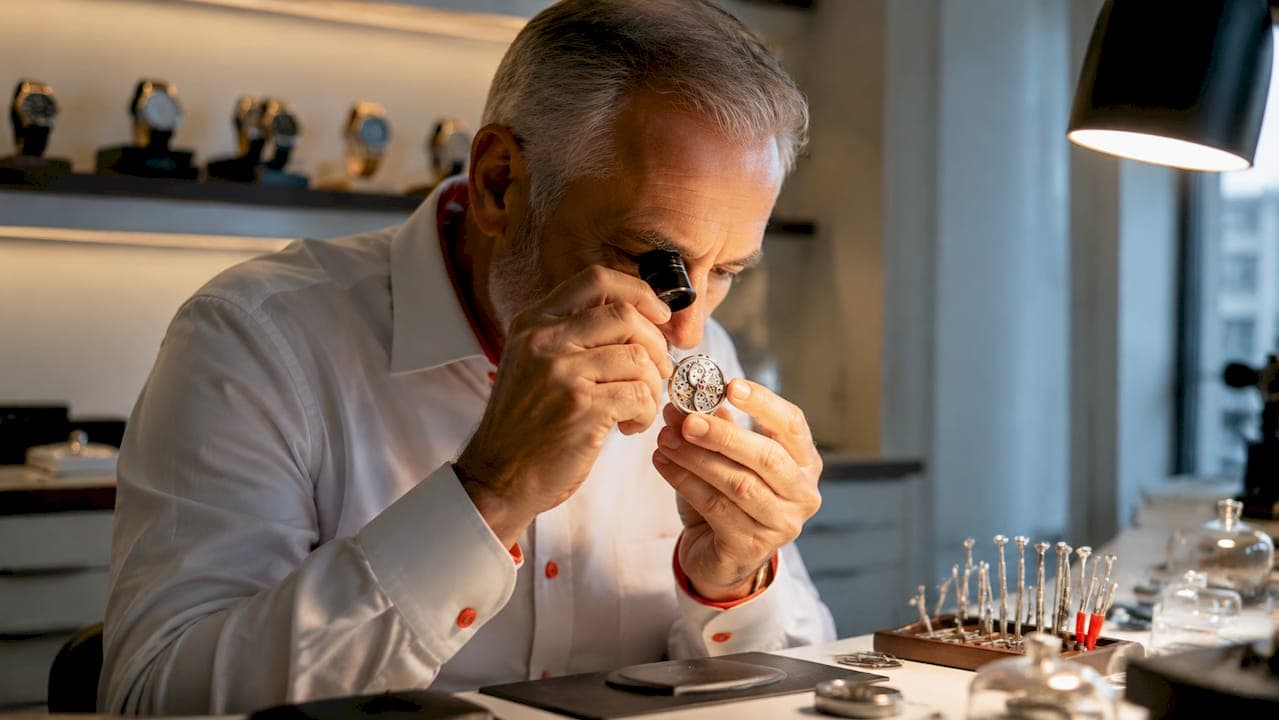
A watch jewel is defined as a synthetic ruby or sapphire bearing embedded in a mechanical movement to reduce friction at pivot points. These precision components are not decorative gems. They are functional engineering elements that determine how accurately and how long a movement runs. For collectors evaluating Patek Philippe, Rolex, Audemars Piguet, or Omega, understanding what a watch jewel does, how many are needed, and how to authenticate them separates informed buying from expensive guesswork.
What are watch jewels and how do they function mechanically?
Jewel bearings consist of a metal spindle rotating within a jewel-lined pivot hole made from synthetic corundum, which is the mineral family that includes both ruby and sapphire. Synthetic corundum is chosen because it is extremely hard, nearly frictionless, and dimensionally stable over decades. Natural gemstones are not used for bearings because their inclusions and inconsistencies would compromise performance.
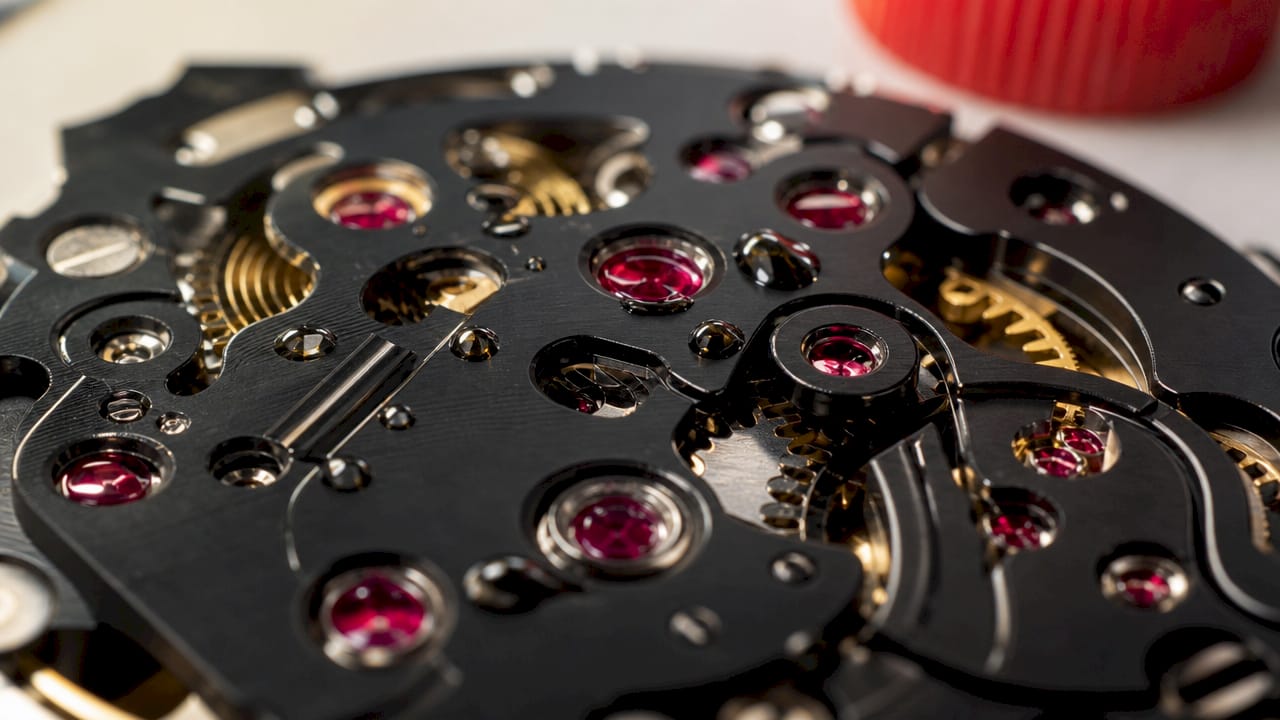
The core job of a watch jewel is to support rotating metal pivots without letting metal grind against metal. Metal-on-metal contact generates heat, wear, and timing drift. Jewels eliminate that contact at the points where it matters most, which are the wheel train pivots, the balance staff, and the escapement.
Three primary jewel types handle different mechanical roles:
- Hole jewels support the radial motion of wheel pivots. They are the most common type and appear throughout the gear train.
- Cap jewels sit above hole jewels at high-wear locations, particularly at the balance wheel. Cap jewels create a small cavity that traps lubricant between surfaces, extending service intervals significantly.
- Pallet jewels are set into the pallet fork and absorb the repeated impact of the escapement. They endure more shock per second than any other jewel in the movement.
Jewels also retain lubricating oil through capillary action. The geometry of a well-cut hole jewel holds oil at the pivot contact point rather than letting it migrate away. This is why jewel shape matters as much as jewel count.
Pro Tip: When examining a movement through an exhibition caseback, look for the deep red color of synthetic ruby jewels at the balance cock. A balance wheel with both hole and cap jewels at each pivot end indicates a properly jeweled, high-grade movement.
How does jewel count relate to watch quality and value?
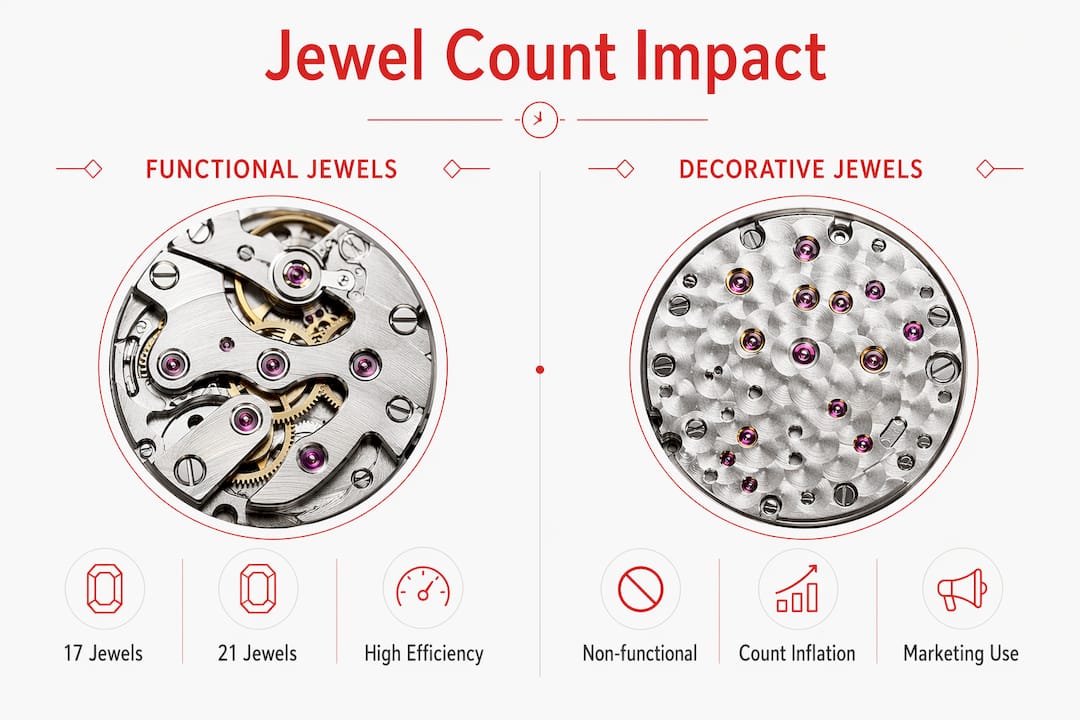
Jewel count is one of the most misunderstood specifications in horology. More jewels do not automatically mean higher quality or greater precision. The number only matters when every jewel counted is functional.
A standard 17-jewel movement covers all friction-critical points in a basic mechanical caliber. A 21-jewel movement typically adds jewels at the barrel arbor and additional wheel pivots. Movements with 25 or more jewels usually include jeweling at the keyless works or additional complications. The table below shows what each count generally represents.
| Jewel count | Typical application | Functional significance |
|---|---|---|
| 17 jewels | Standard mechanical movement | All critical pivot points covered |
| 21 jewels | Enhanced gear train jeweling | Barrel and additional pivots included |
| 25+ jewels | Complicated or high-grade movements | Keyless works and complication pivots jeweled |
| 30+ jewels | Highly complicated or marketing-inflated | Verify each jewel is functional |
The ISO 1112 standard addresses this directly. Only functional jewels may be marked on a watch dial. Non-functional decorative jewels are prohibited from dial indication. That standard exists because some manufacturers historically added jewels with no mechanical purpose to make a movement appear more sophisticated.
A collector buying a watch rated at 35 jewels should ask which specific pivot points those jewels serve. If the seller cannot answer, that is a red flag worth investigating before purchase.
Pro Tip: Cross-reference the jewel count on the dial with the caliber reference number. Most reputable calibers from Rolex, ETA, or Sellita have published technical specifications that list exact jewel placement. Any discrepancy between the dial marking and the caliber spec warrants closer inspection.
What jewel types and designs serve different mechanical roles?
Jewel design is not uniform. Each type has a specific shape engineered for its mechanical task, and the geometry directly affects how well it performs.
Hole jewels come in several profiles. A flat hole jewel has a straight bore and suits lower-speed pivots. An olive hole jewel has a slightly curved bore that centers the pivot automatically, reducing lateral play. This self-centering property makes olive hole jewels the preferred choice for balance wheel staffs, where precision matters most.
- Impulse jewels are a distinct category found on the impulse roller of the balance wheel. They receive the push from the pallet fork with each oscillation. Their shape is typically a small rectangular or elliptical stone set flush into the roller table.
- Pallet jewels come in two forms within the pallet fork: the entry stone and the exit stone. Each one locks and releases the escape wheel alternately. They are set at precise angles, and even a fraction of a degree of misalignment causes timing errors.
- Cap jewels are flat discs with no bore. They do not support radial loads. Their job is purely axial: they cap the end of a pivot and, together with the hole jewel, form the lubricant reservoir described earlier.
The physical hardness of synthetic corundum, rated 9 on the Mohs scale, means these jewels resist wear for decades under normal conditions. That durability is why a properly serviced Omega Speedmaster or Rolex Submariner movement can run accurately for generations.
How do you authenticate natural versus synthetic jewels on luxury watches?
Watch jewels used as bearings are almost always synthetic corundum. Natural rubies are not used for functional bearings because their inconsistencies make them unreliable at the tolerances required. The confusion arises when collectors encounter watches set with decorative colored stones on the dial, bezel, or case, where natural gems may genuinely appear.
Authentication of those decorative stones is a different challenge. Thermal testers cannot reliably distinguish natural rubies from synthetic rubies because their chemical and thermal properties are identical. A thermal probe will read the same result for a natural Burmese ruby and a Verneuil-grown synthetic ruby. This surprises many collectors who assume a thermal tester is sufficient.
Professional authentication requires:
- Inclusion examination under magnification. Natural rubies contain characteristic inclusions like silk (rutile needles) and fingerprint patterns. Synthetic rubies show curved growth lines or gas bubbles.
- UV fluorescence analysis. Natural rubies from certain origins fluoresce differently under longwave UV than synthetic stones.
- Lab certification. Institutions like the Gübelin Gem Lab or the Swiss Gemmological Institute (SSEF) issue origin reports that confirm whether a stone is natural, synthetic, or treated.
- Seller documentation. Clear disclosure and certification from the seller regarding stone origin is the most reliable starting point for any high-value purchase.
For watches set with diamonds or colored stones as luxury watch accessories, always request a gemological certificate before purchase. A Patek Philippe gem-set dial piece without stone documentation is a liability, not an asset.
Pro Tip: If you are buying a gem-set watch at auction, request the lot notes and any accompanying gem reports. Reputable auction houses include stone certificates for significant pieces. Learn more about navigating these situations in this guide on attending watch auctions.
What practical tips help collectors assess and maintain watch jewels?
Evaluating jewel condition and placement requires more than reading a specification sheet. These are the practices that separate serious collectors from casual buyers.
- Use exhibition casebacks. Many modern movements from Rolex, Audemars Piguet, and independent makers expose the movement through a sapphire caseback. Look for the ruby red color of jewels at the balance cock and wheel train bridges. Cloudy or dry-looking jewels suggest the movement needs servicing.
- Request service records. A watch with documented service history from a certified watchmaker confirms that jewels were inspected, cleaned, and re-oiled at appropriate intervals. Loss of lubricating oil increases friction despite jewel presence, so service history is a direct indicator of jewel effectiveness.
- Do not rely on jewel count alone. Visible synthetic rubies may be partly for marketing. Treat the count as a starting point, then verify placement against the caliber's published specifications.
- Consult a certified watchmaker. For high-value acquisitions, a pre-purchase inspection by a certified watchmaker costs a fraction of what a misrepresented movement costs to correct. This is especially relevant for second-hand watch platforms where movement condition varies widely.
- Understand service intervals. Most mechanical movements benefit from servicing every five to seven years. Jewels themselves rarely fail, but the oil around them degrades. Dry jewels accelerate pivot wear even though the jewel surface remains intact.
The watch collecting best practices that experienced collectors follow all point to the same conclusion: documentation and direct inspection outperform specification claims every time.
Key takeaways
Watch jewels are functional synthetic bearings, and their placement and condition matter far more than their count.
| Point | Details |
|---|---|
| Jewels reduce friction | Synthetic corundum bearings prevent metal-on-metal wear at pivot points in mechanical movements. |
| Count does not equal quality | ISO 1112 prohibits decorative jewels from dial markings; verify each jewel serves a mechanical function. |
| Jewel type determines role | Hole, cap, pallet, and impulse jewels each serve distinct mechanical purposes that affect accuracy and longevity. |
| Authentication requires lab testing | Thermal testers cannot distinguish natural from synthetic rubies; professional gem lab reports are the reliable standard. |
| Servicing protects jewel function | Oil degradation increases friction even when jewels are intact; service every five to seven years to maintain performance. |
Why jewel count keeps misleading even experienced collectors
The watch industry has done a poor job of educating buyers about what jewel counts actually mean, and I say that as someone who has spent years evaluating movements across price points from entry-level Swiss automatics to six-figure complications.
The number on the dial is a marketing artifact as much as a technical specification. I have seen 25-jewel movements that performed worse than honest 17-jewel calibers because the extra stones were placed where they added no friction benefit. The movement that matters is the one that has been properly designed, properly lubricated, and properly serviced. Jewel count tells you almost nothing about that.
What I find most underappreciated is the cap jewel. Collectors rarely ask about it, yet it is the component that most directly extends service life by trapping lubricant at the balance staff. A movement with cap jewels at the balance will run cleaner longer than one without, regardless of total jewel count. That is the specification worth asking about.
On authentication, the gap between what buyers assume and what is actually testable is wide. Most collectors trust a thermal tester or a loupe. Neither is sufficient for a high-value gem-set piece. The only defensible standard is a lab report from a recognized institution. If a seller resists providing one, that resistance is the answer.
Timepiecepulse reviews luxury watches with full movement detail
Collectors who want to verify jewel placement, movement specifications, and authentication documentation before buying deserve more than a spec sheet.

Timepiecepulse publishes in-depth luxury watch reviews that cover movement architecture, jewel configuration, and authenticity indicators for watches from Patek Philippe, Rolex, Audemars Piguet, and Omega. Each review is written for collectors and investors who need accurate technical detail, not marketing copy. If you are building a collection or evaluating a specific reference for investment, the Timepiecepulse authorized watch guide gives you the verified information to make that decision with confidence.
FAQ
What is a watch jewel made of?
A watch jewel is made from synthetic corundum, the same mineral as ruby and sapphire. Manufacturers use synthetic stones because they are uniform, extremely hard, and free of the inclusions found in natural gems.
How many jewels does a quality mechanical watch need?
A 17-jewel movement covers all friction-critical pivot points in a standard mechanical caliber. Counts above 17 indicate additional jeweling at the barrel, keyless works, or complications, but only when those jewels are functional.
Can you tell natural rubies from synthetic ones with a thermal tester?
No. Thermal testers cannot distinguish natural rubies from synthetic rubies because their thermal properties are identical. Origin authentication requires inclusion examination, UV analysis, or a certified gem lab report.
Why do some watches advertise very high jewel counts?
Some manufacturers have historically added decorative jewels with no mechanical function to inflate the count. ISO 1112 prohibits these non-functional jewels from being marked on the dial, but the practice persists in marketing materials.
How often should watch jewels be serviced?
Watch jewels themselves rarely wear out, but the lubricating oil around them degrades over time. Most mechanical movements should be serviced every five to seven years to restore oil at jewel contact points and maintain accurate timekeeping.