
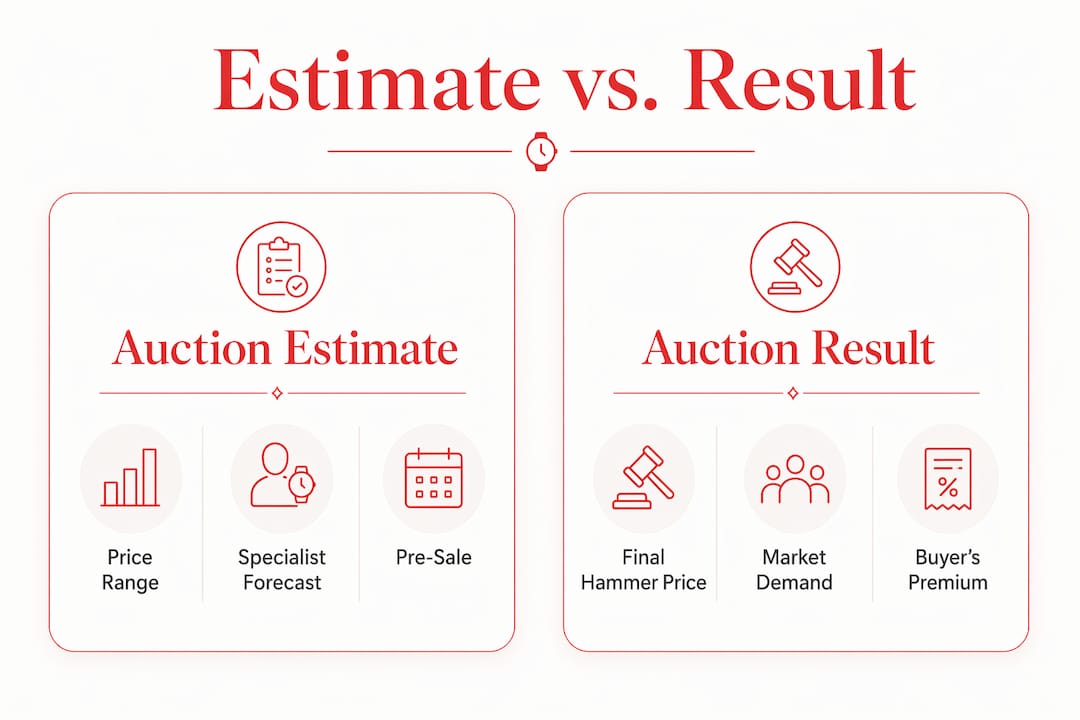
An auction estimate is a specialist-assessed price range predicting where a luxury timepiece might sell, while the auction result is the final, binding hammer price achieved at the sale. Understanding what is auction estimate versus result is the single most important distinction any serious collector or investor can make before entering a bidding room. The estimate guides expectations. The result reveals truth. These two figures rarely match exactly, and the gap between them carries more information than either number alone. Timepiecepulse breaks down both concepts so you can bid with clarity and invest with confidence.
What is auction estimate versus result in luxury watch sales?
An auction estimate is a public price range, expressed as a low and high figure, published before the sale to orient bidders. The auction result is the hammer price confirmed the moment the auctioneer closes bidding. One is a forecast. The other is a transaction.
Estimates are set by in-house specialists who study recent comparable sales, current market sentiment, and the specific attributes of each lot. A Patek Philippe Reference 5711 in exceptional condition with original papers commands a different estimate than the same reference with a replaced bracelet and no box. The estimate reflects that difference before a single bid is placed.

The reserve price sits beneath the estimate and is confidential. Reserve prices are typically set at or below the low estimate, meaning a lot can sell below its published range if bidding stops just above the reserve. Collectors who understand this avoid the common mistake of treating the low estimate as a floor.
Pro Tip: Never treat the low estimate as the minimum a watch will sell for. The reserve is almost always lower, and lots occasionally sell beneath their published range.
How are auction estimates calculated for luxury watches?
Auction house specialists build estimates using a structured set of inputs, not guesswork. Estimates are calculated using historic sales data, condition reports, provenance documentation, and current market demand. Think of the process as similar to a weather forecast: grounded in data, directionally reliable, but never guaranteed.
The key factors specialists weigh include:
- Condition and service history: A Rolex Daytona with an unpolished case and original dial commands a premium over a polished example with a refinished dial.
- Provenance: Documentation linking a watch to a notable owner or original purchase receipt adds measurable value.
- Reference number and caliber: Specific references carry collector premiums. The Audemars Piguet Royal Oak Reference 15202 with its ultra-thin caliber 2121 consistently attracts stronger estimates than standard references.
- Movement finishing: Technical features like the Co-Axial escapement in Omega's caliber 8500 or Zaratsu polishing on case components influence both rarity perception and estimate levels.
- Recent comparable sales: A strong result for a similar reference at a prior sale will push the next estimate upward.
Market sentiment also plays a role. When a particular brand or reference gains visibility through a high-profile sale or media coverage, specialists adjust estimates accordingly. This is why estimates function as tactical anchors designed to encourage bidding momentum, not as fixed valuations. An estimate set too high suppresses interest. One set conservatively generates competition and drives results upward.
Pro Tip: Cross-reference the estimate against recent auction results for the same reference number before bidding. Timepiecepulse's reference number guide explains why specific calibers and references carry persistent premiums.
Why do actual auction results differ from estimates?
The gap between estimate and result is where auction dynamics become genuinely revealing. Auction value is determined by the collective belief of bidders in the room at a specific moment in time, not by financial metrics alone. That reality produces three distinct outcome scenarios:
- Result within estimate: The most common outcome. The lot sells inside the published range, confirming the specialist's read of the market.
- Result above estimate: Competitive bidding, emotional attachment, or unexpected demand pushes the hammer price past the high estimate. This is the scenario that generates headlines. A Patek Philippe grand complication selling at double its high estimate signals a shift in collector appetite that the market will price into future estimates.
- Result below estimate: The lot fails to attract sufficient competition. This can reflect condition issues discovered during viewing, a thin bidder pool, or simply poor timing. A result below estimate is not automatically a bargain. It often signals a problem the specialist missed or a market cooling that warrants investigation.
Most auction items sell near their low estimate, with only roughly 20% of top lots surpassing estimates significantly. That statistic matters because it reframes how collectors should read a strong result. A watch selling at 150% of its high estimate is genuinely exceptional, not a routine occurrence.
Buyer's premiums add another layer of complexity. Buyer's premiums range from 15% to 25% depending on the auction house and the price bracket of the lot. A hammer price of $50,000 becomes a total purchase cost of $57,500 to $62,500 before taxes. Collectors who budget only to the hammer price routinely overspend their actual limits.
How should collectors interpret estimates and results as investment tools?
Auction estimates and results serve different functions in a collector's research toolkit. Estimates tell you where the market expects a watch to land. Results tell you where the market actually placed it. Both signals are useful. Neither is sufficient alone.
The most disciplined approach to auction bidding follows a clear sequence:
- Research recent results for the specific reference across multiple sales, not just the current auction house.
- Set a personal maximum bid based on your own valuation, independent of the published estimate.
- Use the estimate as a calibration check, not a cap. If your research supports a value well above the high estimate, that gap is worth understanding before you bid.
- Calculate your all-in cost before the sale. Total purchase price always includes buyer's premium and applicable taxes. Failing to account for these costs is one of the most common budgeting errors serious investors make.
- Contextualize results with condition and provenance. A result 30% above estimate for a watch with exceptional provenance is rational. The same result for a standard example warrants scrutiny.
Collectors who set their own researched bid limits, rather than following auctioneer estimates, make more disciplined decisions and avoid the emotional escalation that drives overpayment. The auction room is designed to create urgency. Your research is the counterweight.
Understanding auction preparation before you bid transforms estimates from abstract numbers into actionable data points. Timepiecepulse provides the market context collectors need to make that translation accurately.
Auction estimate vs. result: notable luxury watch scenarios
The table below illustrates how technical specifications and auction outcomes interact across select luxury watch references. These figures reflect the types of scenarios collectors encounter in the pre-owned market.
| Reference | Caliber | Power Reserve | Case Dimensions | Water Resistance | Typical Estimate Range | Result Scenario |
|---|---|---|---|---|---|---|
| Patek Philippe 5711/1A | Cal. 315 SC | ~45 hours | 40mm, steel | 120m | $80,000–$120,000 | Frequently exceeds high estimate by 40%+ due to discontinued status |
| Rolex Daytona 116500LN | Cal. 4130 | ~72 hours | 40mm, Oystersteel | 100m | $30,000–$45,000 | Often sells within or just above estimate; condition drives variance |
| Audemars Piguet 15202ST | Cal. 2121 | ~40 hours | 39mm, steel | 20m | $60,000–$90,000 | Results vary widely; provenance and dial originality are decisive |
| Omega Speedmaster 311.30.42 | Cal. 1861 | Manual wind | 42mm, steel | 30m | $8,000–$12,000 | Typically sells within estimate; broad market keeps results stable |
| Patek Philippe 5270G | Cal. CH 29-535 PS | ~65 hours | 41mm, white gold | 30m | $150,000–$200,000 | Grand complications regularly exceed estimate when condition is exceptional |
The Co-Axial escapement in Omega references and the ultra-thin caliber 2121 in the Audemars Piguet 15202 are not marketing language. These technical features directly affect rarity, serviceability, and long-term desirability, all of which specialists factor into estimates and bidders factor into results. A watch with a movement that requires specialized servicing commands a different market than one with widely available parts.
Zaratsu polishing on case flanks, applied by hand to create a distortion-free mirror finish, is another specification that separates standard production from collector-grade examples. Its presence or absence on a pre-owned example affects both the estimate and the result in ways that a photograph alone cannot fully capture.
Key takeaways
The auction estimate is a specialist forecast, not a fixed value. The result is the only number that reflects what the market actually paid, and the gap between them is where the most useful market intelligence lives.
| Point | Details |
|---|---|
| Estimate is a forecast | Specialists set price ranges using sales history, condition, and sentiment, not guaranteed valuations. |
| Results reveal real demand | Hammer prices above estimate signal strong collector appetite; results below warrant careful investigation. |
| Buyer's premium changes the math | Add 15%–25% to the hammer price to calculate your true all-in purchase cost before bidding. |
| Set your own bid limit | Research-based personal maximums protect against emotional escalation in competitive bidding rooms. |
| Technical specs drive variance | Features like Co-Axial escapement and Zaratsu polishing influence both estimates and final results. |
What the auction room actually teaches you
Auction rooms are not neutral environments. They are designed to create competition, urgency, and the sense that the lot in front of you is the last of its kind. I have watched experienced collectors abandon their pre-set limits within 30 seconds of a bidding war, paying 60% above their own research-supported valuation because the room made it feel rational.
The most reliable protection against that outcome is a written maximum bid calculated before you walk in. Not a mental note. A written figure that accounts for the hammer price, the buyer's premium, applicable taxes, and any anticipated service costs. When the auctioneer's rhythm accelerates and the room leans forward, that number is the only thing standing between a sound investment and an expensive mistake.
Estimates deserve respect as data points, not deference as authority. A conservative estimate on a Patek Philippe grand complication is not an invitation to bid conservatively. It is a starting position. Your job as a collector is to know whether the watch is worth more than the estimate before the bidding opens, not after it closes.
The results that genuinely move markets, the Daytona that sells at three times its estimate, the Royal Oak that clears its high estimate by a single bid, are not accidents. They reflect information asymmetry. Someone in that room knew something the estimate did not capture. Building that knowledge base, through consistent result tracking, condition assessment, and provenance research, is the actual work of serious collecting.
Timepiecepulse: your resource for auction-ready research
Knowing the difference between an estimate and a result is the foundation. Knowing which watches to pursue, and at what price, requires deeper market intelligence.

Timepiecepulse publishes detailed luxury watch reviews covering pre-owned market availability, technical specifications, and valuation context for Patek Philippe, Rolex, Audemars Piguet, Omega, and other investment-grade references. Each review is built for collectors who need more than a price range before committing capital. For secure purchasing with full manufacturer warranty coverage, Check live pricing, full manufacturer warranty, and current availability at Authorized Dealer Exquisite Timepieces → https://www.exquisitetimepieces.com/#a_aid=6866cdaee7f19.
FAQ
What is the difference between an auction estimate and a hammer price?
An auction estimate is a pre-sale price range set by specialists to guide bidder expectations. The hammer price is the final amount paid at the close of bidding, which can fall below, within, or above that range.
Are auction estimates reliable for luxury watches?
Estimates are directionally useful but not guarantees. Most lots sell near the low estimate, though top references regularly exceed their high estimates when collector demand is strong.
What is a buyer's premium and how does it affect the total cost?
A buyer's premium is a fee added to the hammer price by the auction house, typically ranging from 15% to 25%. It raises the total purchase cost significantly above the headline result figure.
Why do some watches sell far above their estimates?
Competitive bidding, strong provenance, discontinued production status, and emotional demand all push results above estimates. The Patek Philippe 5711 is a clear example: its discontinuation drove results well past published ranges across multiple major sales.
Should I use the estimate as my bidding limit?
No. Set your own maximum based on independent research before the sale. The estimate is a market anchor, not a ceiling, and bidding beyond your researched limit is the most common source of overpayment at auction.