Incabloc shock protection is defined as a spring-mounted jewel bearing assembly that guards the balance wheel pivots of a mechanical watch against impact damage. Invented in 1934 by Georges Braunschweig and Fritz Marti, the system became an industry standard in Swiss watchmaking and remains so as of 2026. Its core function is straightforward: absorb the energy of a sudden shock before it reaches the most fragile components of the movement. For collectors of Patek Philippe, Rolex, Audemars Piguet, and Omega, understanding this system is not optional. It is the difference between a watch that survives decades of wear and one that requires costly pivot repairs after a single drop.
What is Incabloc shock protection and how does it work?
The balance wheel pivot is the most vulnerable part of a mechanical movement. It is extraordinarily thin, often less than 0.07mm in diameter, and it rotates continuously to regulate timekeeping. Without protection, a sharp knock can snap it instantly.
Incabloc addresses this by placing the jewel bearing that supports the balance staff pivot inside a movable setting. That setting is held in place by a lyre-shaped spring, the signature design element of the Incabloc system. Under normal conditions, the spring holds the jewel firmly. Under shock, the spring flexes and allows the entire jewel setting to shift laterally or vertically.
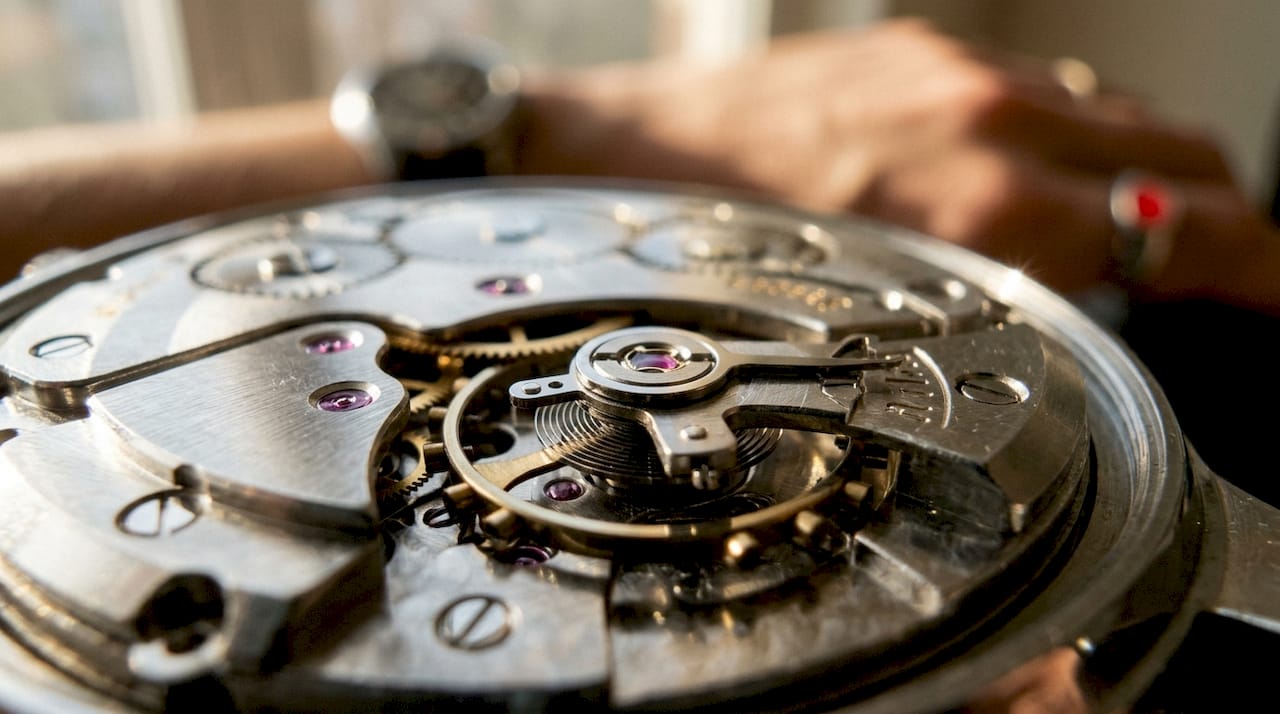
The mechanical logic is elegant. When the watch is dropped or struck, the energy transfers to the shoulder of the balance staff rather than the fragile pivot tip. The shoulder is significantly thicker and can absorb that force without fracturing. The lyre spring absorbs impact across three planes: horizontal, vertical, and diagonal. This three-dimensional protection is what separates Incabloc from earlier, simpler designs.
Once the shock passes, the lyre spring returns the jewel setting to its original position. The balance wheel resumes its oscillation with no lasting disruption to rate accuracy. The entire event takes milliseconds.
Key components of the Incabloc assembly include:
- Lyre-shaped spring: The visual and functional signature of the system, providing controlled flex in multiple directions.
- Movable jewel setting: Houses the endstone and hole jewel, shifting under impact to redirect force.
- Balance staff shoulder: The thicker section of the staff that absorbs transferred shock energy.
- Return mechanism: The spring tension that restores the jewel setting to its resting position after impact.
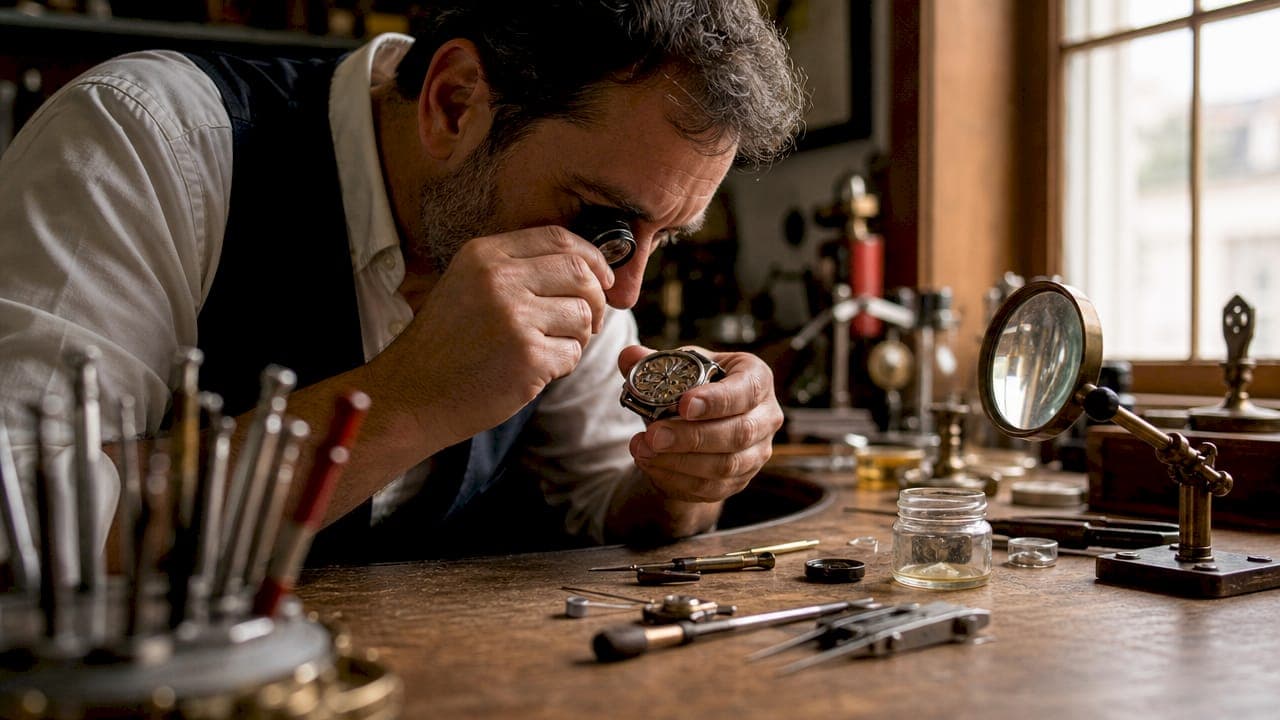
Pro Tip: When examining a movement under a loupe, look for the distinctive curved, lyre-shaped spring at the balance cock. If you see a more linear wire clip or a different spring profile, the watch uses an alternative shock system, not Incabloc.
Incabloc's invention was pivotal for enabling high-frequency precision movements to withstand daily shocks while preserving rate accuracy. That insight drove its widespread adoption across the Swiss industry within two decades of its introduction.
How does Incabloc compare to other shock protection systems?
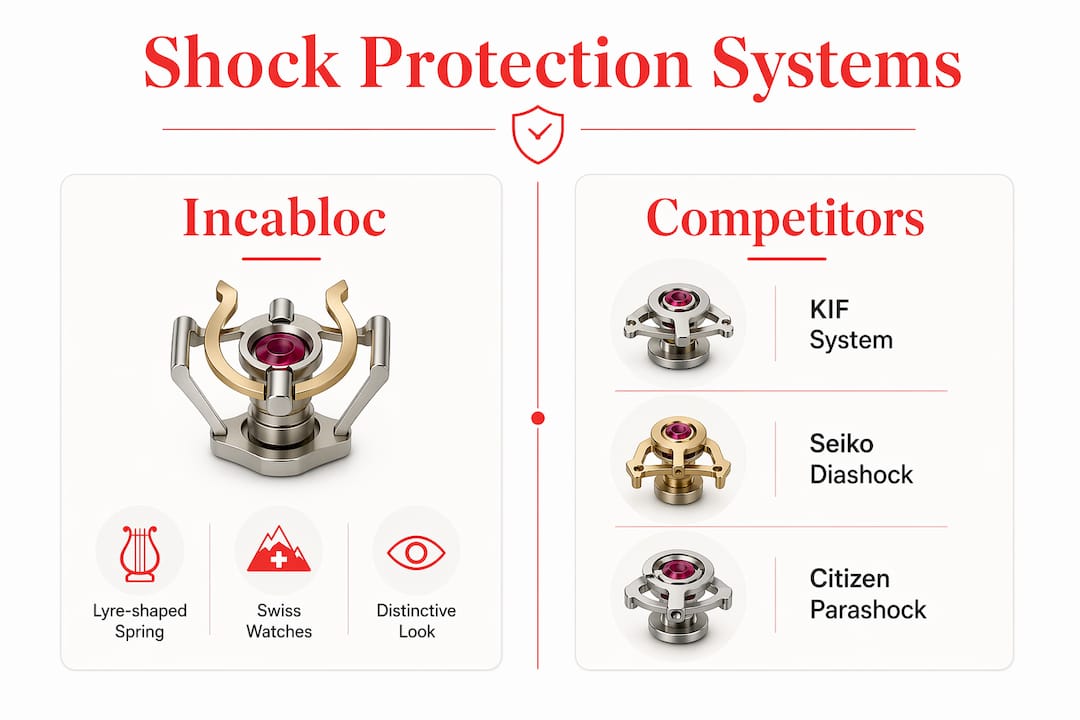
Major shock protection systems in the watch industry include KIF, ETA Etachoc, Seiko Diashock, and Citizen Parashock. All operate on the same fundamental principle: allow the jewel bearing to move under shock and return to position afterward. The differences lie in spring geometry, proprietary design details, and the brands that adopt each system.
The table below compares the primary systems by their defining characteristics.
| System | Spring Shape | Typical Application | Visual Identifier |
|---|---|---|---|
| Incabloc | Lyre-shaped | Swiss mid-to-high-end movements | Curved, symmetrical lyre spring |
| KIF (Kif Flector) | Triangular clip | Swiss luxury and sport movements | Three-point triangular spring |
| ETA Etachoc | Wire clip | Entry-level to mid-range Swiss | Simple wire retaining clip |
| Seiko Diashock | Coil spring | Japanese movements across tiers | Circular coil around jewel |
| Citizen Parashock | Leaf spring | Japanese mid-range movements | Flat leaf spring design |
Incabloc's lyre-shaped spring is visually distinct from all competitors, making it the easiest system to identify under magnification. KIF uses a triangular clip that looks angular by comparison. Etachoc uses a simpler wire clip that experienced collectors recognize immediately as a cost-reduction measure in lower-tier movements.
The mechanical performance differences between Incabloc and KIF are minimal at the level of everyday wear. Both protect against the same range of typical impacts. The practical distinction for collectors is brand context: Incabloc appears in a wide range of Swiss movements from the mid-tier to the high end, while KIF is associated more closely with specific luxury calibers. Knowing which system a movement uses helps you verify authenticity and assess the quality tier of a pre-owned piece.
Why Incabloc matters for collectors and pre-owned buyers
The practical value of Incabloc extends well beyond impact protection. Incabloc assemblies are modular, meaning a watchmaker can remove the entire jewel setting independently during a service. This allows for thorough cleaning and re-oiling of the shock unit without disturbing the rest of the movement. That serviceability is a genuine advantage for long-term ownership.
Shock protection systems like Incabloc reduce the frequency of costly repairs by protecting the movement's most delicate components. A broken balance staff pivot requires disassembly of the entire movement, sourcing a replacement part, and skilled labor. The cost can easily exceed a standard service by a factor of three or more.
Collectors evaluating pre-owned watches should follow this verification sequence:
- Request movement photos. Any reputable seller of a mechanical watch should provide macro images of the movement. Look for the lyre spring at the balance cock.
- Confirm the caliber. Cross-reference the movement caliber with manufacturer documentation to verify that Incabloc is the correct shock system for that reference.
- Inspect under magnification. A 10x loupe reveals the spring profile clearly. A damaged or missing spring indicates the shock protection has been compromised and requires immediate service.
- Check service history. A properly serviced Incabloc unit should have been cleaned and re-oiled at the recommended interval, typically every five years for most Swiss movements.
- Assess overall movement condition. The presence of an intact Incabloc system is one positive indicator, but evaluate dust, debris, and jewel condition holistically.
Incabloc became widely adopted by major Swiss brands by the 1950s, cementing its reputation for reliability in mid-to-high-end mechanical watches. That adoption history means you will encounter it across a broad range of vintage and modern references. Knowing how to identify and assess it gives you a concrete edge when buying pre-owned.
Pro Tip: Incabloc protects against everyday drops and impacts, but it does not prevent damage from extreme vibrations or severe physical trauma. Avoid wearing a mechanical watch during activities involving heavy machinery, power tools, or high-impact sports, regardless of the shock system fitted.
The system does not prevent damage from extreme vibrations such as those encountered in industrial tools or extreme sports. That is a hard limit every collector should internalize. Shock protection is a safety net for daily life, not a guarantee against abuse.
For guidance on authorized service centers that handle Incabloc-equipped movements correctly, Timepiecepulse maintains a dedicated resource covering vetted Swiss service options.
Specifications: selected Incabloc-equipped luxury watch references
The table below presents representative models known to feature Incabloc shock protection. These references span the mid-to-high-end Swiss tier where the system is most prevalent.
| Reference | Caliber | Power Reserve | Case Dimensions | Water Resistance |
|---|---|---|---|---|
| Omega Seamaster 300M (2531.80) | Cal. 1120 | 48 hours | 41mm, steel | 300m |
| Omega Constellation (1502.30) | Cal. 1120 | 48 hours | 35mm, steel/gold | 30m |
| Longines Master Collection (L2.628.4) | Cal. L619 | 64 hours | 40mm, steel | 30m |
| Tissot Le Locle (T006.407) | Cal. ETA 2824-2 | 38–42 hours | 39.3mm, steel | 30m |
| Mido Baroncelli (M8600.4) | Cal. 80 | 80 hours | 38mm, steel | 50m |
These references represent the range of movements where Incabloc appears in production. Omega's Caliber 1120, used across several Seamaster and Constellation references, is a well-documented example of a high-grade Swiss movement fitted with Incabloc as standard. The Longines Caliber L619 similarly benefits from the system in a movement known for its extended power reserve. For collectors focused on automatic Swiss watches as both wearable pieces and investments, these specifications provide a useful baseline for comparison.
Water resistance figures in this table reflect manufacturer ratings under controlled conditions. Real-world water exposure should always be evaluated against current gasket condition, not the original specification alone.
Key Takeaways
Incabloc shock protection is the defining mechanical safeguard for balance wheel pivots in Swiss watches, combining a lyre-shaped spring, modular serviceability, and three-dimensional impact absorption to preserve both accuracy and longevity.
| Point | Details |
|---|---|
| Invented in 1934 | Georges Braunschweig and Fritz Marti created Incabloc, which became a Swiss industry standard. |
| Lyre spring is the identifier | The curved lyre-shaped spring visually distinguishes Incabloc from KIF, Etachoc, and other systems. |
| Three-dimensional protection | The system absorbs horizontal, vertical, and diagonal shocks by redirecting force to the balance staff shoulder. |
| Modular and serviceable | Watchmakers can remove the jewel setting independently, making service more thorough and efficient. |
| Know the limits | Incabloc protects against everyday impacts but not extreme vibrations or severe physical trauma. |
The lyre spring is still the smartest thing in the movement
I have examined hundreds of movements over the years, and the Incabloc assembly still impresses me every time I see it under a loupe. The lyre spring looks almost too simple for what it accomplishes. That simplicity is the point. Complex solutions fail in complex ways. The Incabloc design fails gracefully, if at all.
What I find undervalued in collector conversations is the serviceability angle. Collectors obsess over complications and finishing, but they rarely ask whether the shock system was properly serviced. A dried-out, unlubricated Incabloc spring is worse than no spring at all. It creates false confidence. When I evaluate a pre-owned piece, the shock unit condition tells me more about the watch's service history than almost anything else.
The market for Incabloc-equipped references in the pre-owned space is strong precisely because the system works. Buyers at the $1,000–$5,000 tier are increasingly sophisticated. They know to look for it. If you are building a collection with an eye on pre-owned watch platforms, treat the presence of an intact, serviced Incabloc as a baseline requirement, not a bonus feature.
The tension between tradition and modern shock protection is real but overstated. Newer systems offer marginal improvements in specific performance metrics. Incabloc, after nine decades, remains entirely adequate for any watch worn in normal human life. That is a remarkable engineering legacy.
Authenticated Incabloc watches at Timepiecepulse
Knowing what Incabloc does is only half the equation. Buying a watch that actually has it, intact and properly serviced, requires a trusted source.

Timepiecepulse curates luxury watch reviews covering Swiss mechanical references across the full collector spectrum, from entry-level classics to investment-grade pieces by Patek Philippe, Rolex, Audemars Piguet, and Omega. Each review details movement specifications, shock protection systems, and service considerations so you can make a fully informed purchase. For those ready to acquire, check live pricing, full manufacturer warranty, and current availability at Authorized Dealer Exquisite Timepieces → https://www.exquisitetimepieces.com/#a_aid=6866cdaee7f19.
FAQ
What is Incabloc shock protection in simple terms?
Incabloc shock protection is a spring-loaded jewel bearing system that allows the balance wheel pivot to shift under impact and return to position, preventing the pivot from snapping. It was invented in 1934 and remains a standard feature in Swiss mechanical watches.
How do I identify Incabloc in a watch movement?
Look for the distinctive lyre-shaped spring at the balance cock under a 10x loupe. The lyre spring profile is curved and symmetrical, unlike the triangular clip of KIF or the wire clip of Etachoc.
Does Incabloc make a watch fully shock-proof?
No. Incabloc protects against everyday drops and impacts but does not prevent damage from extreme vibrations or severe physical trauma. The system is a safety net for normal wear, not a guarantee against abuse.
How often should the Incabloc system be serviced?
The Incabloc assembly should be cleaned and re-oiled as part of a full movement service, typically recommended every five years for most Swiss mechanical movements. A dried-out spring loses its protective function.
Which luxury brands use Incabloc shock protection?
Omega, Longines, Tissot, and Mido are among the Swiss brands that have used Incabloc across multiple calibers. The system became widely adopted by major Swiss brands by the 1950s and continues to appear in current production movements.